






How Do Bluetooth Speakers Work? From Pairing to Sound
Press play on your phone and, seconds later, music fills the room from a speaker with no wires attached. It feels like magic, but there is clever engineering behind it. So how do Bluetooth speakers work? In short, your phone sends a compressed digital signal over a short-range wireless link, and the speaker rebuilds it into sound.
This guide breaks down each step, from pairing to the drivers that move the air.

How Bluetooth Speakers Work: A Quick Overview
Here is the whole process in brief. Your phone compresses audio and streams it wirelessly over the 2.4 GHz band to the speaker. The speaker’s chipset receives the signal, a converter turns it back into an analogue waveform, an amplifier boosts it, and the drivers turn it into the sound you hear.
What Is a Bluetooth Speaker?
Let us start with the basics.
A Bluetooth speaker is a wireless speaker that plays audio streamed from a phone, tablet, or laptop over Bluetooth, with no cables between the two. It holds everything needed to receive and play sound: a Bluetooth receiver, a battery or mains power, audio electronics, and one or more drivers. Because the link is wireless, you can keep your phone in your pocket and still control playback from across the room.
So, how does the Bluetooth speaker work? It splits the job into two halves: the wireless link that carries the music, and the audio hardware that turns it into sound.
How Does a Bluetooth Speaker Connect to Your Phone?
Before any music plays, the two devices have to find each other.
Bluetooth uses the 2.4 GHz ISM radio band, the same unlicensed spectrum many wireless devices share. The standard is maintained by the Bluetooth SIG. Connecting happens in three quick stages.
- Pairing: you put the speaker in pairing mode, and your phone finds it in its Bluetooth list.
- Bonding: the two devices swap security keys and remember each other for next time.
- Streaming: your phone sends audio using the A2DP profile, the Bluetooth standard for stereo music.
This handshake is the first step in how wireless Bluetooth speakers work, and it takes just a few seconds. After the first pairing, the speaker reconnects automatically whenever it is in range.
Key Components Inside a Bluetooth Speaker
Understanding how Bluetooth wireless speakers work comes down to four parts that turn the signal into sound.
Bluetooth Chipset
First, the chipset handles the wireless side.
The Bluetooth chipset receives the radio signal and decodes the compressed audio back into digital data. It also manages pairing, connection stability, and which codec the speaker and phone use together.
DAC (Digital-to-Analog Converter)
Next, the signal has to become analogue.
Sound in the real world is analogue, but Bluetooth carries it as digital data. The DAC, or digital-to-analogue converter, rebuilds that data into a continuous electrical waveform. A high-quality DAC converts digital audio data into a smooth analogue signal while helping preserve sound detail.
Amplifier
That waveform is far too weak to drive a speaker on its own.
The amplifier boosts the low-level signal from the DAC to a level strong enough to move the drivers. It needs to add power without adding distortion, which is why amplifier quality has a big effect on loudness and clarity.
Drivers
Finally, the drivers make the air move.
Drivers are the cone-shaped units that turn the electrical signal into sound waves. A voice coil moves the cone back and forth, pushing air to create the pressure changes your ears detect as sound. Dedicated woofers and tweeters handle different frequencies, from deep bass to crisp highs.
Audio Codecs and How They Affect Sound Quality
A codec decides how audio is compressed for the wireless trip, and it shapes the final quality.
SBC and AAC
These two are the most common.
- SBC: the default codec every Bluetooth speaker supports. It is reliable and efficient, with solid everyday quality.
- AAC: more efficient than SBC at the same bitrate, and the codec iPhones use for Bluetooth audio.
aptX and LDAC
For higher quality, two codecs go further.
- aptX: built for lower latency and better detail, which helps with video and gaming when both devices support it.
- LDAC: a high-resolution codec that can transmit more data than SBC, helping deliver higher-quality Bluetooth audio when both devices support it.
Both the phone and the speaker must support the same codec, or they fall back to SBC.
What Affects Bluetooth Speaker Sound Quality?
Codecs are not the whole story. Several other factors shape what you hear.
DSP Tuning and Volume Management
Software does a lot of the heavy lifting.
DSP, or digital signal processing, fine-tunes the audio inside the speaker, balancing frequencies, protecting the drivers, and keeping the sound clean at high volume. soundcore’s BassUp technology analyses low frequencies in real time and enhances bass performance for a more powerful listening experience. In the soundcore app, a custom EQ lets you shape the sound to your taste.
Speaker Placement and Environment
Where you put the speaker matters as much as what is inside it.
- Place the speaker on a solid surface to cut rattle and reinforce bass.
- Move it away from a corner if bass sounds boomy, or use a corner to add low end.
- Reduce obstacles between the speaker and your device to keep the connection stable.
This is also part of how portable Bluetooth speakers work in the real world: the room and placement change the sound as much as the hardware does.
Recommended soundcore Bluetooth Speakers for Different Listening Scenarios
Now for the fun part: choosing the right speaker for how you listen. Explore our full range of Bluetooth speakers to match every setting. Here is how three favourites compare.
|
Model |
Output |
Battery |
Water resistance |
Standout feature |
Best for |
|
soundcore Rave 3S |
200W |
Up to 12h |
IPX4 |
AI karaoke, light show |
Parties and large spaces |
|
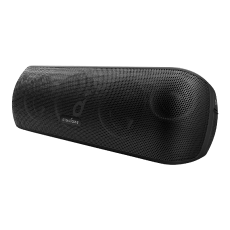
soundcore Motion X600 |
50W |
Up to 12h |
IPX7 |
Spatial audio, LDAC |
Immersive home listening |
|
soundcore Boom Go 3i |
15W |
Up to 24h |
IP68 |
Pocket size, power bank |
Everyday and outdoor use |
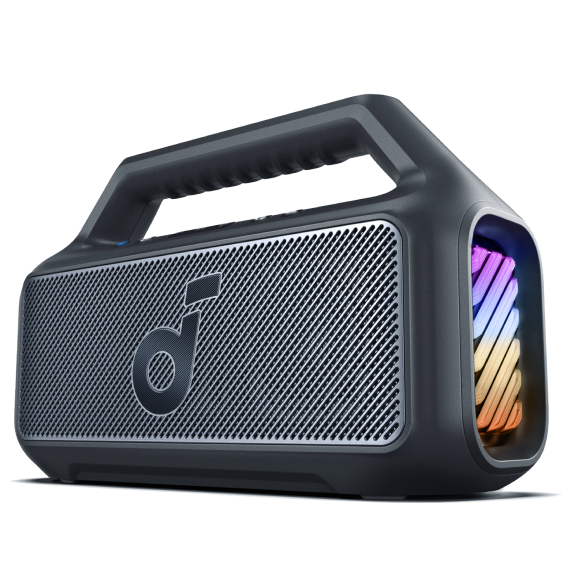
soundcore Rave 3S – High-Power Bluetooth Speaker for Parties and Large Spaces
The soundcore Rave 3S is built to fill large spaces. It delivers 200W through a 6.5-inch woofer and three 2.5-inch full-range drivers, reaching a room-filling 108 dB. Connect over Bluetooth, and its AI Vocal Removal strips vocals from any track for instant karaoke, backed by two wireless microphones and a beat-synced light show.
- Output: 200W, up to 108 dB, with BassUp
- Drivers: 6.5" woofer plus three 2.5" full-range drivers
- Battery: up to 12 hours
- Durability: IPX4 splash resistance
- Connectivity: Bluetooth, Auracast, and TWS pairing
- Extras: dual wireless microphones, AI Vocal Removal, app EQ and lightin

soundcore Motion X600 – Premium Portable Speaker with Immersive Audio
The soundcore Motion X600 focuses on high-fidelity sound. Five drivers and five amplifiers produce 50W of spatial audio, with an upward-firing driver that lifts sound around the room. It supports Hi-Res and the LDAC codec for near hi-fi streaming, and an IPX7 rating keeps it safe from splashes.
- Output: 50W spatial audio, with 5 drivers and 5 amplifiers
- Audio: Hi-Res, High Fidelity, and LDAC (Android 8.0 and above)
- Battery: up to 12 hours
- Durability: IPX7 waterproof
- Connectivity: Bluetooth 5.3, 3.5mm aux-in, and TWS pairing

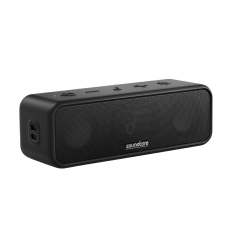
soundcore Boom Go 3i – Compact Bluetooth Speaker for Everyday and Outdoor Use
The soundcore Boom Go 3i packs big features into a palm-sized body. It delivers 15W with BassUp 2.0 and a 92 dB peak, weighs just 380g, and clips to a bag with its 2-in-1 strap. An IP68 rating and up to 24 hours of battery make it ideal for hikes, cycling, and the beach, and a built-in power bank tops up your phone. Its IP68 rating helps protect against dust and water, making it ready for outdoor adventures.
- Output: 15W with BassUp 2.0, up to 92 dB peak
- Battery: up to 24 hours, with a 4,800mAh power bank
- Durability: IP68 dust- and waterproof, 1-metre drop resistance
- Connectivity: Bluetooth 6.0
- Design: 380g, palm-sized, with a 2-in-1 strap

Conclusion
To recap, how do Bluetooth speakers work: they take a compressed digital signal from your device, rebuild it into an analogue waveform, amplify it, and push it through drivers to create sound, all over a wireless link.
Once you know the parts, choosing gets easier: the Rave 3S for parties, the Motion X600 for immersive listening, and the Boom Go 3i for life on the move. Whichever you pick, the technology fades into the background, and the music takes over.
FAQs
Does a Bluetooth speaker need WiFi?
No. A Bluetooth speaker connects directly to your device over Bluetooth, not Wi-Fi, so it works with no internet or router. That is why it plays anywhere, from the garden to the beach. Wi-Fi speakers exist too, but they need a network. For most people, Bluetooth is the simpler, more portable choice.
How do Bluetooth speakers get power?
Most Bluetooth speakers run on a built-in rechargeable lithium-ion battery, charged over USB-C. Portable models like the Boom Go 3i last up to 24 hours per charge and can even top up your phone. Larger home or party speakers may also plug into the mains for continuous use during long sessions.
How far can Bluetooth reach?
Most Bluetooth speakers work within about 10 metres, or 33 feet, of your device. Open space extends that range, while walls, floors, and other wireless signals shorten it. Newer Bluetooth versions improve stability and can reach further outdoors. For the best connection, keep your device and speaker within sight of each other.


