






How to Select the Right Speaker Size for Your Room
Designing the ideal sound system for your home depends on more than just picking the most costly gear; it's about attaining a sense of balance. Good speakers should make your space better. They should make sounds that are clear and full without being too loud or too quiet. If you want a cool Bluetooth speaker for relaxing sometimes or planning a whole hi-fi setup for really enjoying music, one thing is really important—the size of your room.
Don't worry. This guide will explain the most important things to consider, one step at a time. We will address every aspect of your room's acoustics, including an in-depth examination of its technical specifications. The sole aim is to help the right speaker be selected for the space, ensuring an impeccably balanced auditory delight is delivered with every press of play.

Understanding How Room Size and Acoustics Affect Sound
Before the selection of specific speaker models, the taking of a moment for the calm assessment of your room is recommended. Ultimately, the acoustic characteristics of the listening environment are predominantly dictated by its spatial configuration, including its dimensions, arrangement, and the positioning of furnishings. These elements exert a direct influence on the ultimate auditory experience.
Take, for example, a roomy living room and a snug study. These two spaces can offer very different acoustic experiences and may require different types of the speaker. A number of significant elements merit your consideration: the dimensions of the room and the height of the ceiling dictate the extent to which 'air movement' is necessary to produce deep, resonant bass; interior furnishings are also pivotal – plush carpets, drapes and seating absorb surplus echoes, while smooth surfaces, expansive windows and unadorned walls tend to generate sound reflections that compromise clarity.
Finally, ask yourself the question of the primary function of this room. Is it intended for dedicated music appreciation, setting up a home cinema, or just providing soothing ambient listening? The answer will gently show you the best speaker for you, based on things like how powerful it is, how it sounds, and how it makes you feel. It will make sure that the speaker is just right for your life.
Measuring Your Space and Calculating Volume
The first step is to avoid relying on estimates. A tape measure should be got out and the length, width and height of the room should be measured accurately (in metres). Keep in mind, accuracy is paramount. Then the space's cubic volume can be calculated effortlessly by multiplying these three figures together – length × width × height.
This cubic metre measurement is far more useful than square footage alone for audio purposes, as it accounts for the total air space. The impact of ceiling height on sound is something you might not be aware of. To illustrate, two rooms boasting equivalent floor areas yet disparate ceiling heights will possess vastly divergent volumes, a factor that exerts a direct influence on the dimensions and auditory capacity of the loudspeakers one should elect. Positioning compact driver loudspeakers in a spacious area can result in thin, stifled audio; on the other hand, packing substantial speaker into a confined space frequently yields bass that is dull and indistinct, lacking in precision. Even when it is not being used very loud, you might not be able to hear the details.
The Impact of Room Furnishings and Materials
The things in a room (the furniture and decorations) are just as important as the size of the room. Imagine a room with nice floors, big windows and not many things on the walls. This is not good for sound. It makes sounds echo too much, there is a lot of background noise, and it is hard to listen. The occurrence of this is due to the repeated bouncing of sound off hard surfaces, resulting in its blending with the direct sound heard. The result is a disagreeable auditory experience, somewhat muddled in its effect.
However, there is a way out! If your room has thick carpets, soft sofas, velvet curtains, or bookshelves, these things can stop sound from spreading. They successfully subdue surplus reflections, making audio more pure, sturdier and accurate. When choosing the speaker, first of all, you need to know what kind of room you have. Is it a lively room (highly reflective) or a quiet room (heavily absorbed)? If your space feels a bit "stuffy", think about the speaker with brighter middle and high sounds to make the sound more exciting. But if you can hear a lot of reflections, choose models with softer high frequencies. This will make the sound more comfortable.

Defining Your Listening Goals and Purpose
Don't be confused by all the information about the speaker. The most pivotal step in selecting a speaker is to introspect and discern your intended utilisation of them. Different situations require different characteristics in speakers. If you want to enjoy films at home, the most important thing is that they look and sound great. Concentrate on low-frequency performance – detonations must produce profound, resonant bass notes that dissipate pure, without interference during intense audio sequences. In short, the sound must be powerful yet clear.
When it comes to immersive music appreciation, you'll probably place a high value on audio fidelity. Expressions such as a roomy soundscape, exact imaging and unbiased calibration fundamentally signify perceiving every nuance in the recording, as if the musician and group are playing directly in front of you.
However, if one merely seeks ambient music for moments of repose or to accompany quotidian tasks, convenience frequently eclipses unassailable fidelity. Bluetooth connectivity that requires only one touch, ease of use, and a sound quality that stays enjoyable for long periods of time become the more sensible options. In the final analysis, the optimal speaker is that which is suited to the individual. To find the right speaker for you, it's important to be clear about your primary usage needs.
Decoding Speaker Specifications for Your Space
Choosing the right speaker means knowing the details. They do give clear points to work with, but more importantly, you need to understand what they mean for the way you actually hear music. There are several important measurements that need to be looked at closely:
- Driver size: It is generally quantifiable in either inches or millimetres. This has a direct impact on how well a speaker can move air around. Basically, bigger drivers tend to find it easier to handle bass. So, larger rooms are usually better for speakers with bigger drivers. But smaller spaces do not need to follow the size rule.
- Capacity management and responsiveness: The loudness of a speaker is largely determined by these parameters when they are combined. The efficiency with which the speaker converts power into sound is represented by sensitivity, measured in decibels (dB). If something is more sensitive, it can achieve a greater volume with less power. It is also easier to connect to different amplifiers.
- Frequency response range: This technical detail shows the range of the audio frequency band that the loudspeaker can play, including low, mid and high frequencies. It shows the speaker's overall tone and low sounds, helping you see if it has a balanced sound or makes some sounds louder than others.
The details are always the same, but people are always changing. The only way to truly assess the quality of sound is to listen to it in real-time.
Driver Size and Configuration Explained
The drivers are the physical components within a speaker that create sound. Their size and combination directly impact performance. A driver's size, as indicated by its numerical value, is deceptive; it has a direct impact on a speaker's internal components. By and large, more substantial drivers – such as 6.5-inch or larger bass drivers – have the capacity to displace a greater volume of air, thus facilitating the production of robust, full-bodied bass and ensuring the efficient filling of larger spaces.
Conversely, clear, detailed midrange vocals and instrumentation are often delivered by smaller drivers (such as 3-4 inches). But if you've got a bigger room, the bass might not be as strong. When it comes to these kinds of setups, it's usually best to pair them with a subwoofer. Most rooms can handle a common two-way system, you know, like one bass driver and one tweeter.
For the majority of homes, two-way loudspeakers are really all you need. Nevertheless, if you insist on superior audio quality, especially in bigger venues, then think about three-way speakers. Distinct driver roles are featured in these systems: vocals and primary instruments are handled by a dedicated midrange driver, rhythm and ambience are managed by a bass driver, while detail and overtones are reproduced by a tweeter.
Understanding Power (Wattage) and Sensitivity
Watts (W) represent the amplifier power a speaker can handle and convert into sound. However, wattage alone is not a perfect indicator of loudness. This is where sensitivity becomes critical.
Sensitivity is basically a way of measuring how good a speaker is. It signifies the maximum potential output of the loudspeaker, measured in decibels, when subjected to a power output of one watt at a distance of one metre. The ease of driving the speaker is directly proportional to the sensitivity. So, if you've got a speaker with 90dB sensitivity and you connect it to the same amplifier as one with 84dB sensitivity, you'll definitely notice it's way louder. Consequently, room size is pivotal when picking speakers:
- Large rooms: When you're picking models, go for ones that are higher in sensitivity (like 90dB+). And make sure they can handle more power (around 100W+). This makes sure the sound is loud and clear.
- Small rooms: High power isn't always the best option, so don't just go for it. Speakers that are not too sensitive and can handle less power are perfectly fine. This approach is not only economical but also eliminates the potential for inadvertently causing any disturbance to neighbours.
Frequency Response and Bass Performance
A speaker's frequency response range, measured in Hertz (Hz), indicates the spectrum of sound it can reproduce—from the deepest bass to the highest treble. A wider range is generally better, particularly for low-frequency performance, resulting in a more powerful and immersive listening experience. For example, a speaker that reaches down to 45Hz can reproduce deeper kick drums and cello sustains than one limited to 60Hz.
However, don’t fixate solely on the numbers! Smoothness and flatness of the frequency response are equally important. A balanced and accurate sound requires both wide and even coverage across the spectrum.
Room size should also influence your choice:
- In larger rooms, aim for speakers capable of very low bass (<50Hz) to create a full, enveloping sound.
- In smaller rooms, excessive bass extension may cause unwanted boominess due to room resonance, so ultra-deep bass is less essential.
Ultimately, specifications are only a guide—trust your own ears when making the final decision.
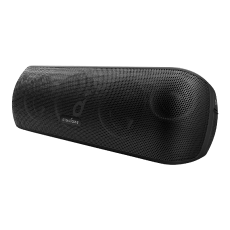
A Premier Choice for Midsize to Large Rooms: soundcore Motion X600
For those seeking a powerful, all-in-one audio solution that masters midsize to large rooms, soundcore Motion X600 Bluetooth speaker is an exemplary choice. It is engineered with a unique spatial audio system, featuring one upward-facing driver and four tweeters that work in concert to create a remarkably wide and immersive soundstage, making it feel like the sound is coming from all around you.
With a total output of 50W and a dedicated high-excursion woofer, it delivers punchy, distortion-free bass that can effortlessly pressurise a large living room or fill a garden space. The speaker's sophisticated design is complemented by LDAC technology for high-resolution audio streaming and an IPX7 waterproof rating, making it as durable as it is powerful. For a seamless blend of room-filling performance, innovative design, and portable convenience, Motion X600 stands out as a top-tier audio solution.


