








Small Bluetooth Speaker or Large Speaker: Which Size Suits You Best?
Many people listen to music throughout the day, moving between rooms, balconies and outdoor spaces. How a speaker fits into that routine often matters more than raw audio specs alone.
At the same time, social settings create very different expectations. A quiet evening at home and a weekend gathering need very different audio setups, so choosing between a small Bluetooth speaker and a large one is not always straightforward.
Large vs Small Bluetooth Speakers: The Core Differences
Size and Portability
A compact Bluetooth speaker is usually small enough to hold in one hand and carry around without effort. It often fits neatly into a backpack or onto a kitchen shelf, which makes it practical for everyday movement.
Portability affects how often you actually use the speaker. A lighter model can move from the bedroom to the kitchen or balcony without a second thought, while a heavier one is more likely to stay in one place.
In smaller homes or flats, that flexibility matters. You can listen while cooking, then move the speaker to the living room or outdoors. A small Bluetooth speaker handles this naturally, while larger models usually require more planning.
Bluetooth Speaker Power and Volume
Bluetooth speaker power is often reduced to watt figures, but the number alone does not tell the whole story. Different sizes are designed for different listening distances and environments.
How many watts make a good speaker depends on how you plan to use it. Lower output works well for close-up listening, while higher power is more useful in larger spaces.
In practice, a small speaker can sound clear at short range, while a larger one keeps its presence and clarity across a room or outdoors. The difference is less about quality and more about reach.
Typical Use Cases
Different speaker sizes naturally fit different situations.
Small speakers are usually best for:
- Personal listening by a desk or bedside
- Travel and outdoor walks
- Everyday use as a compact home speaker
Large speakers are more suitable for:
- Social gatherings with more people
- Outdoor use where sound needs to travel further
- Parties where stronger output is essential
Portable Speaker Comparison: Compact, Mid-Size and Large Bluetooth Speakers
Feature |
Motion 300 |
Motion X600 |
Rave 3S |
Speaker type |
Small Bluetooth speaker |
Mid-size portable speaker |
Large Bluetooth speaker |
Power |
30W |
50W |
200W |
Portability |
Very high |
Moderate |
Low |
Best use |
Travel and everyday listening |
Home and small gatherings |
Parties and events |
Battery life |
13 hours |
12 hours |
Long party sessions |
Waterproofing |
Yes (IPX7) |
Yes (IPX7) |
Yes |
Sound coverage |
Personal / small room |
Living room |
Large spaces |
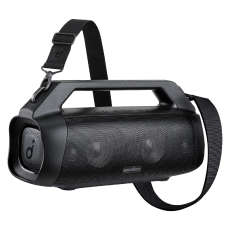
Small Bluetooth Speaker: soundcore Motion 300
A small Bluetooth speaker such as the Motion 300 works best when portability is your main priority. It is easy to carry, store and use in different rooms without much effort.
This type of speaker often becomes part of your daily routine. It can sit on a kitchen counter, move to your desk or head outdoors without any special setup. That flexibility is one of the main reasons many people choose a compact Bluetooth speaker over a larger model.
The Motion 300 delivers 30W of output, which is enough for indoor listening and occasional outdoor use. It also maintains balanced sound when placed in different positions thanks to adaptive tuning.
Its compact size makes it well suited to travel, while waterproof protection improves reliability outside the house. For users focused on portability, this type of speaker is often the most practical choice.
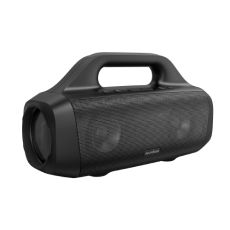
Mid-Size Portable Speaker: soundcore Motion X600

A mid-size option sits between portability and power. It offers stronger output while still being manageable to move around the home.
The Motion X600 provides 50W of output, which is enough to fill a living room without the need for a larger system. That makes it a strong choice for people who want a home speaker with more presence while keeping decent portability.
Its multi-driver setup helps distribute sound more evenly across a room. Although it is larger than a typical small Bluetooth speaker, it can still move between rooms when needed.
This type of speaker works well for both personal listening and smaller gatherings. It is a balanced option for users who want more volume without stepping up to a full-size large Bluetooth speaker.
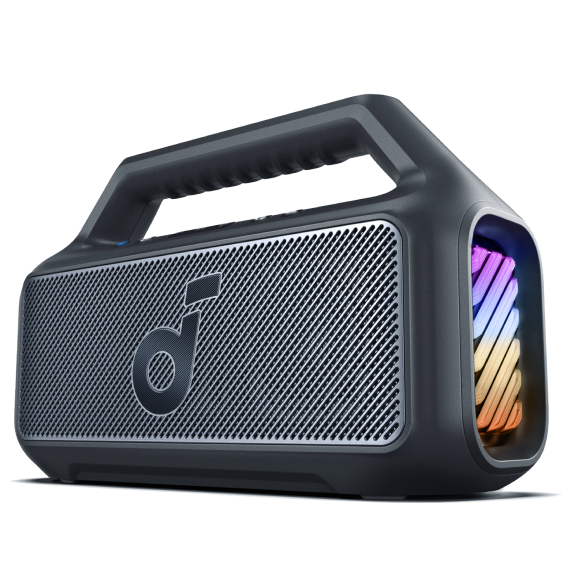
Large Bluetooth Speaker: soundcore Rave 3S

A large Bluetooth speaker becomes essential when sound needs to cover a wider area. Quiet indoor listening does not require that level of output, but outdoor and group settings often do.
The Rave 3S delivers 200W of power, allowing it to maintain strong volume across larger areas. That is especially useful outdoors, where sound disperses quickly.
It is designed as a party speaker, with built-in microphones that support karaoke and group entertainment. Lighting effects also add a visual element to social events.
This kind of speaker is less portable, but it meets the needs of gatherings where loud, consistent sound matters most.
Which Speaker Size Matches Your Needs?
Choosing between a small Bluetooth speaker and a large one depends mainly on your space and listening distance.
For personal listening or smaller rooms, a compact model is usually enough. It gives you clear sound without taking up much space and is easier to move around.
For smaller gatherings, a mid-size speaker offers a better balance. It can fill a room without becoming awkward to handle.
For larger spaces or outdoor use, stronger output becomes more important. A large party speaker helps ensure the sound reaches everyone without strain or distortion.
How Many Watts Make a Good Speaker?
Understanding wattage helps clarify what to expect from different speaker sizes.
- 10–20W works well for close personal listening
- 20–50W suits typical home use
- 50–100W supports smaller gatherings
- 100W+ is better for parties and outdoor use
This range shows that Bluetooth speaker power should match the environment. Too much power indoors often goes unused, while too little limits how far the sound carries.
The most useful approach is a balanced one. Focus on how and where you listen rather than simply choosing the highest wattage available.
Conclusion
Speaker size directly affects how you use it. A small Bluetooth speaker fits daily routines and smaller spaces, while a large Bluetooth speaker is better suited to social settings and outdoor use.
When choosing a Bluetooth speaker, it helps to think about where you will use it most often. Matching size and power to your environment leads to a more practical setup.
soundcore offers options across all three categories, which makes it easier to find a model that suits your everyday listening habits.
FAQs
1. Is one large speaker better than two small ones?
Two smaller speakers can create wider stereo coverage indoors, while one larger speaker provides stronger overall output. The better option depends on your space and how evenly you want sound to spread.
2. Are larger Bluetooth speakers better?
Not automatically. They are simply designed for different situations, especially where higher volume and broader coverage are needed.
3. Does speaker size affect sound quality?
Size affects how sound fills a space, but not necessarily overall quality. Smaller speakers can still deliver clear sound at close range.
4. How much power does a Bluetooth speaker use?
Power use varies by size and volume level. Higher-output speakers consume more energy, especially at louder volumes.
5. How do you choose a good Bluetooth speaker?
Start by identifying where you will use it most often. Then match speaker size, portability and power to that setting for the most practical result.


